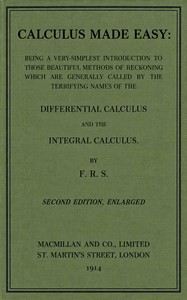
L'introduzione più semplice a derivate e integrali: il classico per chi inizia l'analisi.
EPUB
Incipit
Le prime righe
PREFACE TO THE SECOND EDITION. THE surprising success of this work has led the author to add a considerable number of worked examples and exercises. Advantage has also been taken to enlarge certain parts where experience showed that further explanations would be useful. The author acknowledges with gratitude many valuable suggestions and letters received from teachers, students, and-critics. October, 1914. PROLOGUE CONSIDERING how many fools can calculate, it is surprising that it should be thought either a difficult or a tedious task for any other fool to learn how to master the same tricks. Some calculus-tricks are quite easy. Some are enormously difficult. The fools who write the textbooks of advanced mathematics—and they are mostly clever fools-seldom take the trouble to show you how easy the easy calculations are. On the contrary, they seem to desire to impress you with their tremendous cleverness by going about it in the most difficult way. Being myself a remarkably stupid fellow, I have had to unteach myself the difficulties, and now beg to present to my fellow fools the parts that are not hard. Master these thoroughly, and the rest will follow. What one fool can do, another can. CHAPTER I. TO DELIVER YOU FROM THE PRELIMINARY TERRORS. THE preliminary terror, which chokes off most fifth-form boys from even attempting to learn how to calculate, can be abolished once for all by simply stating what is the meaning-in common-sense terms-of the two principal symbols that are used in calculating. These dreadful symbols are: (1) d which merely means "a little bit of." Thus d x means a little bit of x; or d u means a little bit of u. Ordinary mathematicians think it more polite to say "an element of," instead of "a little bit of." Just as you please. But you will find
Edizioni e download
Il calcolo reso facile
en · 1910 · Edizione digitale · IT
L'introduzione più semplice a derivate e integrali: il classico per chi inizia l'analisi.
Licenza: PD-IT. Pubblico dominio in Italia (autore morto nel 1916). Fonte: https://www.gutenberg.org/ebooks/33283
Nuovi libri
Vuoi sapere quando aggiungiamo un libro?
Ricevi la newsletter settimanale di ContaChiaro, con i nuovi libri gratis: niente pubblicità, niente riempitivi. La conferma arriva via email, così sei tu a scegliere.
GratisChiaro pubblica solo libri gratuiti e legalmente distribuibili. Licenza, fonte e attribuzione
sono indicate per ogni edizione; se un formato non è disponibile, il libro resta consultabile nella
scheda e rimanda alla fonte autorizzata.